

Why invest in real estate in Hungary?

Why invest in real estate in Hungary?
Are you looking to make a real estate investment in Hungary? Here's what you need to know about this real estate market that has been booming for several years.
Hungary has seen an increase in foreign investment for several years. However, some investors remain hesitant to venture into a real estate market they are unfamiliar with.
Investing in a foreign real estate market offers an additional possibility when local real estate markets prove too expensive or can no longer offer attractive rental returns.
To give an overview of the market and the reasons for its attractiveness, let's highlight 6 key factors: the ease of access to Hungary for foreign real estate investors, Hungary's economic growth, its dizzying real estate growth, foreign investment statistics, prices and taxes on a real estate purchase in Hungary, and the reasons for the country's international attractiveness.
Easy access to Hungary
L’aéroport de Budapest continue son expansion et le nombre de passagers ne cessent d’augmenter.
Many companies (including low-cost carriers) operate a large number of flights across Europe from there.
As foreign investors, it is therefore very easy to travel to Hungary quickly and even for very short periods.
Hungarian economic growth in figures
Hungary's economic growth is in the upper range compared to other countries in the European Union.
C’est ainsi que sur l’année 2018, la croissance a été de 4.6% et les prévisions de 2019 sont tout aussi florissantes.
Real estate growth in Hungary
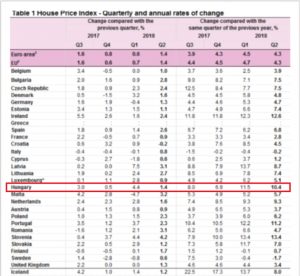
Les statistiques d’Eurostat, tel que mesuré par l’indice des prix de l’immobilier, évoquent une augmentation moyenne des prix de l’ordre de 4,3% au sein de la zone euro et de l’union européenne pour la deuxième partie de 2018 et ce comparativement à la même période un an plus tôt.
Hungary, with a growth of 10.4%, is among the 4 European countries that have recorded the highest real estate growth.
According to Eurostat, Hungary has recorded the highest growth since 2015, with an increase of 31%, just ahead of Ireland and Latvia.
Security of real estate transactions in Hungary
Selon les statistiques, à l’échelle nationale, un investissement immobilier en Hongrie sur vingt en Hongrie a été effectué par un non-résident et en 2018, 9% des acheteurs étaient des investisseurs étrangers.
If we move the cursor to certain districts (like the 5th district in Budapest), one in three buyers was foreign.
Furthermore, as it is a member state of the European Union, no restrictions are imposed. Foreign investors can own real estate under the same conditions as nationals.
Pour le surplus, nous nous renvoyons à l’article détaillant la procédure d’acquisition d’un bien immobilier en Hongrie.
The price and various taxes involved in a real estate investment in Hungary
What makes Hungary so attractive is both the property prices and the various taxes on property transactions.
Although the price per square meter in Budapest has skyrocketed, numerous investment opportunities remain, whether in emerging districts or in secondary cities with strong rental potential.
Taxes on real estate purchases are low and help keep the final cost down. In particular, we should point out:
- Registration fees: 4% of the purchase price
- Lawyer's fees: 1% of the purchase price
- Property tax: 5.6 euros / m²
- VAT on new constructions: 5% (until 2023)
- Taxation on actually taxable rents: 15%
The attractiveness and appeal of real estate investment in Hungary
Budapest is one of the most popular destinations in the world. The city was ranked the second most beautiful city in the world to visit by the renowned CN Traveler magazine.
Its architecture, the quality of its food and wine, its safety and its exceptional thermal baths make it a very special destination.
The country also has excellent universities that attract tens of thousands of students each year.
It is also a prime destination for targeted medical tourism, particularly for dental care and thermal spa treatments for retirees.
Real estate investment in Hungary for nursing homes is also experiencing significant growth in several regions of the country.
CONCLUSION
The real estate market in Hungary has experienced strong growth in recent years. There has also been an influx of foreign investors for several years.
One consequence is the impressive rise in prices in desirable districts of Budapest, with an impact on rental yields, which nevertheless remain attractive compared to the rest of the European Union.
Furthermore, there are still many opportunities to seize, particularly in:
- buying in emerging districts;
- favoring secondary cities with high rental potential;
- having access to properties not found on the traditional real estate market.
Logement pour étudiants en Hongrie : quel futur?
Are you a property owner in Hungary?
We connect your property with serious international investors, ready to buy under the best conditions.
Ready to invest in Hungarian real estate?

